
Stadium
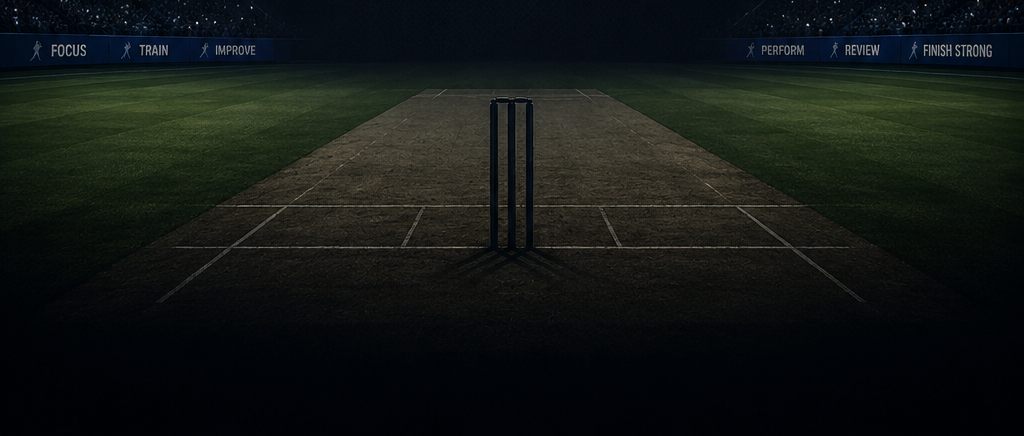
A floodlit night stadium — packed stands and boundary boards, graded like a TV broadcast.
- Moves
- Camera flashes pop in the crowd.
- On the hit
- The crowd and their phone torches rise in a wave.
Pick a scene and your net session plays out somewhere else — a floodlit stadium, a jungle temple, a neon street in the rain. Every scene is a painting drawn by code, on your phone, that moves through your clip — and in many, the moment you hit the ball sets something off. And the next one could be yours.
Every scene leaves a doorway, an arch or a window where your batter stands, and builds its world around that opening — so the cricket is never covered.
A floodlit night stadium — packed stands and boundary boards, graded like a TV broadcast.
A glowing round viewport on a starship deck, looking out on a ringed planet.
A burning, eye-shaped opening between erupting volcanoes, under hanging ash.
A carved stone doorway sinking into the jungle, hung with vines.
A giant ringed worm bursting up through the dunes — with the batter in its mouth.
A city at night across a lake, flowering trees, and a flyover arch over the batter.
A gilt keyhole cut through a great tree, with roses, toadstools and a top hat.
A hallway made of code, with doors of light down both walls.
Looking straight up a rain-soaked neon street canyon.
A beach at sunset under two crossing palms, with a lighthouse on the point.
A neon portal in a fan of peacock feathers, on a dry lake bed at night.
Tournament morning on a big city ground, under a scalloped banner arch.
A lacquered gateway at sunset, ninja murals holding bats, a snow-capped volcano behind.
The arched gate of a whitewashed sea fort, a clock tower and a beach beyond.
A ground by the sea, with a flat-topped mountain across the bay.
A country oval in the bush: an iron-roofed grandstand and gum trees full of parrots.
A county ground by a river as a summer shower passes, a cathedral beyond.
Cricket on the sea ice beside a polar station, with penguins and an iceberg.
Each card is a sketch of the scene’s palette and its opening, not a frame from the scene — they look best moving, in the app. Pick one per clip, or one for the whole reel.
A scene isn’t a video file or a downloaded picture. It is drawn, line by line, by code that runs on your phone when you export — so scenes cost no data, work offline, and fit any frame from a vertical Reel to a wide YouTube cut.
A place, a time of day, and the one thing nobody forgets about it. The name comes early, and it names the kind of place, never a real brand or landmark.
Where the batter stands, what fills the band across the top, what moves through the clip, what happens on the hit, the light and the palette — agreed in words first.
Skies, walls, crowds and lanterns built up layer by layer: soft gradients, one light, haze for distance. A reference picture gives the shape; the art is drawn from scratch.
Checked in portrait and landscape, close up and far away, around a real batter — never covering them, never too dark to read, and still alive when the clip ends.
A sketch on paper, a photo you took, an AI image you made, or just a paragraph. The strongest ideas become real scenes in the app — and you can be credited by name.
A brand that wants a scene of its own is a commission — see CricCuts for brands.
Paste up to three links below — Google Drive, Dropbox, your own site — and tell us where each picture came from. Or email them to support@criccuts.com with your scene’s name in the subject.
Fill in the form and it builds a prompt that frames the image the way scenes are made — the opening in the centre, the story across the top, no text or logos. Copy it into your image tool, then link the result.
The form saves as a scene brief file our build tools read directly. Start from the blank template or the worked example, and import it back into the form to send.
The essentials take about three minutes. Everything under “More detail” is optional but helps a lot. Fields marked * are required.
Every one, and we reply by email — whether or not we can take it further.
We turn your idea into a design brief, and may write back with questions about the opening, the colours or the hit.
Painted in code and measured over real batting, round after round, until it is right.
In an app update, with your name in the credits if you asked for it.
Honestly: a new scene takes weeks of drawing and testing, so we can’t build every idea, and the one we build may change a lot on the way. We’ll tell you either way.